Replacing mysql_field_name() for column names
mysql_field_name() returned the name of a result-set column from the removed PHP MySQL extension. Current code can obtain column names from the database schema or from result metadata.
Historical mysql_field_name()
<?php
// Historical only.
$q = mysql_query('SELECT * FROM student ORDER BY id');
$name = mysql_field_name($q, 0);
echo $name;
?>
Column names from SHOW COLUMNS
SHOW COLUMNS FROM student;PDO: build a heading row from schema metadata
<?php
$columns = $dbo->query('SHOW COLUMNS FROM student');
echo '<tr>';
foreach ($columns as $column) {
    echo '<th>' . htmlspecialchars($column['Field']) . '</th>';
}
echo '</tr>';
?>
PDO columnCount() for a result
<?php
$stmt = $dbo->query(
    'SELECT id, name, class, mark FROM student'
);
echo 'Number of columns: ' . $stmt->columnCount();
?>
MySQLi fetch_fields()
<?php
$result = $connection->query(
    'SELECT id, name, class, mark FROM student ORDER BY id'
);
echo '<tr>';
foreach ($result->fetch_fields() as $field) {
    echo '<th>' . htmlspecialchars($field->name) . '</th>';
}
echo '</tr>';
?>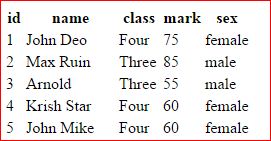
The original goal—using field names as table headings—is preserved without mysql_num_fields(), mysql_fetch_row(), or PHP's removed each() function.
Related tutorials
Number of fields · Column metadata · Field types · Student SQL dump · MySQLi overview

Subhendu Mohapatra
Author & Instructor at plus2net
I write and maintain practical tutorials on Python, PHP, SQL, JavaScript, HTML, jQuery, and web development at plus2net. The tutorials focus on clear explanations, working examples, and code that readers can test and adapt while learning.


Subscribe to our YouTube Channel here

 SQL Video Tutorials