Build an AJAX Search with PHP and MySQL
Search with fetch() and a prepared PHP query
The live example sends a URL-encoded search term to ajax-search-demock.php. The PHP endpoint validates input and runs a prepared query against the student table. The basic select-list response is HTML with database values escaped before output; the separate datalist demo requests JSON.
Use the first copyable example with the search input and results container in the live demo below. The next examples explain the XMLHttpRequest equivalent and the PHP query. Always check responses and abort outdated search requests.
Copyable fetch() example
// Use this on the live select-list demo with #keyword and #displayDiv.
const input = document.getElementById('keyword');
const results = document.getElementById('displayDiv');
let pendingRequest;
input.addEventListener('input', async () => {
if (pendingRequest) pendingRequest.abort();
const term = input.value.trim();
if (!term) { results.replaceChildren(); return; }
pendingRequest = new AbortController();
const request = pendingRequest;
try {
const response = await fetch('ajax-search-demock.php?txt=' + encodeURIComponent(term),
{ signal: request.signal });
if (!response.ok) throw new Error('Search failed');
const safeHtml = await response.text();
if (pendingRequest === request) results.innerHTML = safeHtml;
} catch (error) {
if (error.name !== 'AbortError') results.textContent = 'Search unavailable.';
}
}); Use AJAX to search database records as the user types. The advantage of this is we are not waiting for the full keyword to be typed and then submit to get the matching records. As you type, the browser sends the search text to PHP over AJAX and the result is displayed below the text box.
By watching the result returned by the database we can modify our search keyword.
This is a simple one field matching search only. We have not used other fields or dynamic keyword combinations to get the result from the table.
Our search query uses SQL Like statement to get the matching records from the table.
You can learn the basics of using GET method in Ajax to post form data here
Try the AJAX search demo Try datalist suggestions
The basic example has a browser demo and a PHP search endpoint. The modern
fetch() example is shown first; the XMLHttpRequest form demonstrates the same request without fetch().
HTML and XMLHttpRequest:
ajax-search-demo.php
<!-- Main markup for the XMLHttpRequest version -->
<label for="keyword">Student name</label>
<input type="search" id="keyword" autocomplete="off">
<div id="displayDiv" aria-live="polite"></div>
<script>
const input = document.getElementById('keyword');
let request;
input.addEventListener('input', () => {
  if (request) request.abort();
  const term = input.value.trim();
  if (!term) { document.getElementById('displayDiv').textContent = ''; return; }
  const current = new XMLHttpRequest();
  request = current;
  current.open('GET', 'ajax-search-demock.php?txt=' + encodeURIComponent(term));
  current.onload = () => {
    if (request !== current) return;
    if (current.status === 200) {
      // The PHP endpoint escapes database values before producing select markup.
      document.getElementById('displayDiv').innerHTML = current.responseText;
    }
  };
  current.send();
});
</script>
The endpoint prepares the
LIKE query with a bound parameter and escapes database text in the returned HTML. The complete endpoint also checks database errors and can return JSON for the datalist demo. PHP backend:
ajax-search-demock.php (abbreviated example; the downloadable endpoint also supports JSON for the datalist demo)
<?php
header('Content-Type: text/html; charset=UTF-8');
$term = $_GET['txt'] ?? '';
if (!is_string($term) || strlen($term) > 60 ||
!preg_match('/^[\p{L}\p{M}0-9 .\x27-]+$/u', trim($term))) {
http_response_code(400);
exit('Invalid search term.');
}
require '../include/z_db1.php'; // PDO connection is provided as $dbo.
$stmt = $dbo->prepare('SELECT name, id FROM student WHERE name LIKE :term ORDER BY name LIMIT 15');
$stmt->execute(['term' => '%' . trim($term) . '%']);
echo '<select id="search-results" size="10" aria-label="Matching students">';
foreach ($stmt->fetchAll(PDO::FETCH_ASSOC) as $row) {
$id = htmlspecialchars((string) $row['id'], ENT_QUOTES | ENT_SUBSTITUTE, 'UTF-8');
$name = htmlspecialchars((string) $row['name'], ENT_QUOTES | ENT_SUBSTITUTE, 'UTF-8');
echo '<option value="' . $id . '">' . $name . ' => ' . $id . '</option>';
}
echo '</select>';
?>
Advance keyword search using Ajax PHP and MySQL
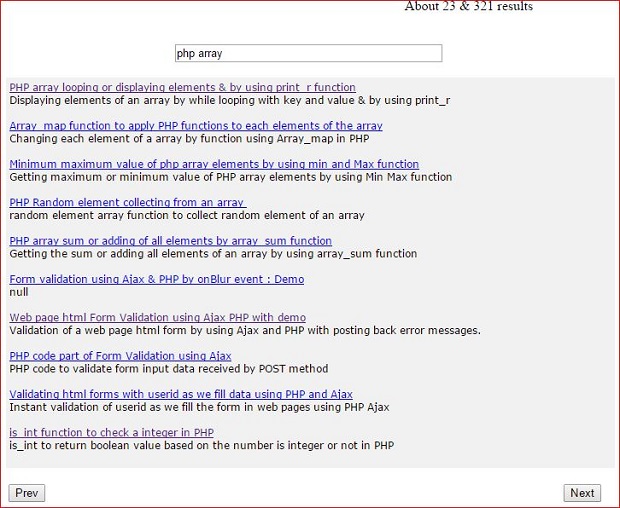
To understand this script you must know how to use Ajax, Json, Paging of records and SQL. In addition to this you must read how we break a string and prepare keyword linked query.
Using the above concept we can develop a script to search database. To prepare the table we have used the title tags of php section of this site. We kept all the text inside title tag of PHP Section tutorials and apply search to this.
Suggesting matching records by using a datalist
Try the datalist autocomplete demo. It requests format=json from the same endpoint and creates each <option> with DOM methods, so returned names are treated as text rather than HTML.
const response = await fetch(
  'ajax-search-demock.php?format=json&txt=' + encodeURIComponent(term),
  { headers: { Accept: 'application/json' } }
);
if (!response.ok) throw new Error('Search failed');
const names = await response.json();
const datalist = document.getElementById('student');
datalist.replaceChildren();
for (const name of names) {
  const option = document.createElement('option');
  option.value = String(name);
  datalist.append(option);
}
As the user types, the browser sends the search term to the PHP endpoint and uses the matching names as options of the datalist. You can also review the HTML datalist basics.
Searching with multiple keywords.
It is likely that users will search for multiple keywords where we have to return any matching word. For example if we search for the sentence plus2net demo then our script should find out records having word plus2net or word demo in the title field. So the query string should be like this.select title from TABLE where title like '%plus2net%' or title like '%demo%'Multiple keywords
Users are likely to search multiple keywords. Say for example we search for the words PHP MySQL Ajax. Now the best result is where all three words present in the page. So we will search for pages where all keywords present and place them ahead of other results. After placing these results then we will search for records where any one of the keyword is present. Now we will join these two results and return to visitors.Here we have not kept any algorithm to rank search results. We will match only keywords in title or description column. That can be developed That is the technique used by search engines and success depends on indexing and developing complex search algorithm to give better user experience.
Paging of Records
We should not show all the records (results ) in a single page. It is better we show limited records pages ( say 10 records ) and allow visitors to navigate forward or backward to other pages by using buttons.Json
Along with records we will also return several other data to the users so we will use Json for returning data to users.Try searching for Ajax PHP MySQL script etc.
Ajax Json XML

Subhendu Mohapatra
Author & Instructor at plus2net
I write and maintain practical tutorials on Python, PHP, SQL, JavaScript, HTML, jQuery, and web development at plus2net. The tutorials focus on clear explanations, working examples, and code that readers can test and adapt while learning.


Subscribe to our YouTube Channel here

| John | 24-08-2013 |
| Awesome tutorial... Keep posting Ajax tutorials.. | |
| sopha | 23-10-2013 |
| I like your website | |
| Chinthaka | 01-06-2014 |
| Wow fantastic !!! 100% working | |
| Arshad | 28-09-2014 |
| Always Rocking Plus2net.com! My PHP site was created by the help of Plus2net! Thank you! so much.. | |
| John | 12-07-2015 |
| Fatal error: Class 'PDO' not found | |
| smo1234 | 17-07-2015 |
| Inside config.php file read the database connection part. | |
| Imran | 09-08-2018 |
| This works good but for very much low records in table. I have inserted 0.2 Million records in table and then i used this technique believe me my site got stuck after few requests. Do you have any solutions for big data searching with ajax. | |
