Displaying records in PHP from MySQL table
Display records with MySQLi and escape HTML output
The first example uses a prepared statement for a class filter and escapes database values before displaying them in HTML. The later examples demonstrate object-oriented MySQLi, procedural MySQLi, PDO and filtering variations. Each is independent: create a fresh MySQLi connection using the first example before trying another variation, or initialize PDO using the linked tutorial.
<?php
mysqli_report(MYSQLI_REPORT_ERROR | MYSQLI_REPORT_STRICT);
$connection = new mysqli('localhost', 'db_user', 'db_password', 'database_name');
$connection->set_charset('utf8mb4');
$class = 'Four';
$stmt = $connection->prepare('SELECT id, name, class, mark FROM student WHERE class = ? ORDER BY id');
$stmt->bind_param('s', $class);
$stmt->execute();
$result = $stmt->get_result(); // Requires mysqlnd.
while ($row = $result->fetch_assoc()) {
    echo htmlspecialchars($row['name'], ENT_QUOTES, 'UTF-8') . ' - ';
    echo htmlspecialchars($row['class'], ENT_QUOTES, 'UTF-8') . '<br>';
}
$result->free();
$stmt->close();
$connection->close();
?>
| id | name | class | mark |
|---|---|---|---|
| 1 | John Deo | Four | 75 |
| 2 | Max Ruin | Three | 85 |
| 3 | Arnold | Three | 55 |
| 4 | Krish Star | Four | 60 |
| 5 | John Mike | Four | 60 |
| 6 | Alex John | Four | 55 |
| 7 | My John Rob | Fifth | 78 |
Before starting please ensure that you have connected to MySql database and also check the article on PHP MySQL query to know how to execute MySql queries by using PHP
Let us first start by storing the query in a variable and then executing it
MySQLI database connection file
Example : Object Oriented Style
<?php
// First create $connection as shown in the complete example above.
$result_set = $connection->query('SELECT id, name, class, mark FROM student LIMIT 5');
while ($row = $result_set->fetch_assoc()) {
    echo (int)$row['id'] . ' - ';
    echo htmlspecialchars($row['name'], ENT_QUOTES, 'UTF-8') . ' - ';
    echo htmlspecialchars($row['class'], ENT_QUOTES, 'UTF-8') . ' - ';
    echo (int)$row['mark'] . '<br>';
}
$result_set->free();
?>
| $connection | Connection object Declared inside config.php file |
| $result_set | For a successful SELECT, query() returns a mysqli_result. With strict error reporting, failures throw mysqli_sql_exception. |
| fetch_array | Returns row of data from result set as array of string. NULL is returned if no more row is available to return. |
These examples display the name, class and mark for each record. The HTML
<br> gives one line
break after each record. This can be formatted well to display inside a
table.
| id | name | class | mark | sex |
|---|---|---|---|---|
| 1 | John Deo | Four | 75 | female |
| 2 | Max Ruin | Three | 85 | male |
| 3 | Arnold | Three | 55 | male |
| 4 | Krish Star | Four | 60 | female |
| 5 | John Mike | Four | 60 | female |
<?php
// First create $connection as shown in the complete example above.
$query = 'SELECT id, name, class, mark FROM student LIMIT 5';
$result_set = mysqli_query($connection, $query);
while ($row = mysqli_fetch_assoc($result_set)) {
    echo (int)$row['id'] . ' - ';
    echo htmlspecialchars($row['name'], ENT_QUOTES, 'UTF-8') . ' - ';
    echo htmlspecialchars($row['class'], ENT_QUOTES, 'UTF-8') . ' - ';
    echo (int)$row['mark'] . '<br>';
}
mysqli_free_result($result_set);
?>
Using MySQLi
MySQLi connection<?php
// First create $connection as shown in the complete example above.
$result_set = $connection->query('SELECT id, name, class, mark FROM student');
echo 'Number of records: ' . $result_set->num_rows . '<br>';
while ($row = $result_set->fetch_assoc()) {
echo (int)$row['id'] . ' - ';
echo htmlspecialchars($row['name'], ENT_QUOTES, 'UTF-8') . ' - ';
echo htmlspecialchars($row['class'], ENT_QUOTES, 'UTF-8') . ' - ';
echo (int)$row['mark'] . '<br>';
}
$result_set->free();
?>
Using PDO
This separate example requires a PDO connection in $dbo; see the PDO connection tutorial. For queries with visitor-supplied values, use PDO prepared statements.
<?php
// $dbo must be an initialized PDO MySQL connection.
$sql = 'SELECT id, name, class, mark FROM student LIMIT 5';
echo '<table><tr><th>ID</th><th>Name</th><th>Class</th><th>Mark</th></tr>';
foreach ($dbo->query($sql, PDO::FETCH_ASSOC) as $row) {
    echo '<tr><td>' . (int)$row['id'] . '</td>';
    echo '<td>' . htmlspecialchars($row['name'], ENT_QUOTES, 'UTF-8') . '</td>';
    echo '<td>' . htmlspecialchars($row['class'], ENT_QUOTES, 'UTF-8') . '</td>';
    echo '<td>' . (int)$row['mark'] . '</td></tr>';
}
echo '</table>';
?>
Displaying single record
From the above code we can create links to display full details of the record. We will carry unique id of the record through query string and then display the single record.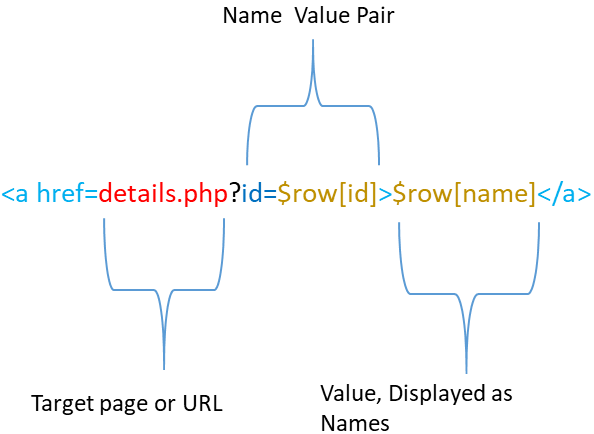
Displaying single record per page
Breaking number of records to multiple pages
When our output have more number of records to display and we want to display few records ( say 10 only ) per page then we can use Paging concept to limit the number of records per page. We will add navigational links to move between pages to display all records.Breaking number of records by PHP paging
Filtering records.
By adding SQL commands like WHERE conditions we can filter data as per our requirements. Let us find out the records of class Four only.// A fixed filter is safe as a literal.
$query = "SELECT id, name, class, mark FROM student WHERE class = 'Four'";
// If $class comes from user input, use the prepared statement shown first.
PHP MySQL Query with Error message

Subhendu Mohapatra
Author & Instructor at plus2net
I write and maintain practical tutorials on Python, PHP, SQL, JavaScript, HTML, jQuery, and web development at plus2net. The tutorials focus on clear explanations, working examples, and code that readers can test and adapt while learning.


Subscribe to our YouTube Channel here

| mariel | 16-02-2012 |
| thank you...it works.. | |
| Simon | 22-02-2012 |
| Thanks dude, this tutorial helped me a lot. | |
| Atar | 25-05-2012 |
| Hi can you tell me how to insert date month and year combine in databese | |
| Venedict Francisco | 07-09-2013 |
| how can i post or display data information from the two different table? | |
| smo1234 | 09-06-2015 |
| You can always combine more than one table and display information. You can select multiple tables in a select statement and join more than two tables by using LEFT join Check SQL section for more details. | |