Pandas read_clipboard(): Read Pasted Tables and Desktop Clipboard Text
Use read_clipboard() with the local operating-system clipboard. Practise the same table parsing and text formatting in Colab using the portable examples below.
Read pasted table text in Colab 🔝
import pandas as pd
import tempfile
import sqlite3
from pathlib import Path
from io import StringIO
pasted = 'NAME\tID\tMATH\tENGLISH\nRavi\t1\t30\t20\nRaju\t2\t40\t30\nAlex\t3\t50\t40\n'
df = pd.read_csv(StringIO(pasted), sep="	")
print(df)
assert df["NAME"].tolist() == ["Ravi", "Raju", "Alex"]
Expected output
   NAME  ID  MATH  ENGLISH
0  Ravi   1    30       20
1  Raju   2    40       30
2  Alex   3    50       40
Read the desktop clipboard 🔝
run_desktop = False  # Set True only in local Python after copying a table.
if run_desktop:
    local_table = pd.read_clipboard(sep="	")
    print(local_table)
else:
    print("Desktop clipboard read is disabled; use the pasted-text examples.")
Expected output
Desktop clipboard read is disabled; use the pasted-text examples.Parse whitespace and keep names with spaces 🔝
console = 'NAME ID MATH ENGLISH\nRavi 1 30 20\nRaju 2 40 30\nAlex 3 50 40\n'
simple = pd.read_csv(StringIO(console), sep=r"\s+")
print(simple)
names = pd.read_csv(StringIO('id\tname\n1\tJohn Deo\n'), sep="	")
assert names.loc[0, "name"] == "John Deo"
print(names)
Expected output
   NAME  ID  MATH  ENGLISH
0  Ravi   1    30       20
1  Raju   2    40       30
2  Alex   3    50       40
   id      name
0   1  John Deo
Choose an em-dash separator and Python engine 🔝
functions_text = 'function—description\nstrlen—Return string length\ntrim—Remove surrounding whitespace\n'
functions = pd.read_csv(StringIO(functions_text), sep="—", engine="python")
print(functions)
assert functions.columns.tolist() == ["function", "description"]
Expected output
  function                    description
0   strlen           Return string length
1     trim  Remove surrounding whitespace
Keep identifiers and validate missing values 🔝
records = '001\t75\n002\tpending\n'
typed = pd.read_csv(StringIO(records), sep="	", header=None,
    names=["id", "mark"], dtype={"id": "string"}, na_values=["pending"])
print(typed)
assert typed["id"].tolist() == ["001", "002"]
assert typed["mark"].isna().sum() == 1
Expected output
    id  mark
0  001  75.0
1  002   NaN
Save imported data as CSV and Excel 🔝
with tempfile.TemporaryDirectory(dir=Path.cwd()) as folder:
    csv_file = Path(folder) / "my_clipboard.csv"
    excel_file = Path(folder) / "my_clipboard.xlsx"
    df.to_csv(csv_file, index=False)
    df.to_excel(excel_file, index=False, engine="openpyxl")
    pd.testing.assert_frame_equal(pd.read_csv(csv_file), df)
    pd.testing.assert_frame_equal(pd.read_excel(excel_file, engine="openpyxl"), df)
    print("CSV and Excel round trips passed")
Expected output
CSV and Excel round trips passedCreate an HTML table from imported text 🔝
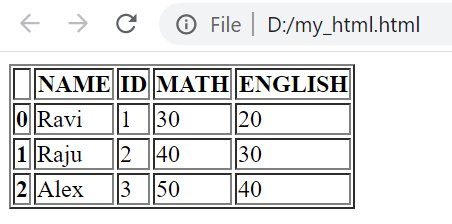
table_html = df.to_html(index=False, escape=True)
print(table_html)
with tempfile.TemporaryDirectory(dir=Path.cwd()) as folder:
    target = Path(folder) / "my_html.html"
    target.write_text(table_html, encoding="utf-8")
    assert target.read_text(encoding="utf-8") == table_html
Expected output
<table border="1" class="dataframe">
  <thead>
    <tr style="text-align: right;">
      <th>NAME</th>
      <th>ID</th>
      <th>MATH</th>
      <th>ENGLISH</th>
    </tr>
  </thead>
  <tbody>
    <tr>
      <td>Ravi</td>
      <td>1</td>
      <td>30</td>
      <td>20</td>
    </tr>
    <tr>
      <td>Raju</td>
      <td>2</td>
      <td>40</td>
      <td>30</td>
    </tr>
    <tr>
      <td>Alex</td>
      <td>3</td>
      <td>50</td>
      <td>40</td>
    </tr>
  </tbody>
</table>
Common clipboard import pitfalls 🔝
Copy a rectangular table with a consistent delimiter. Avoid merged cells, extra titles and footnotes. sep and engine are parsing choices; changing engine does not repair a missing clipboard service. A local/headless backend may report PyperclipException when unavailable. Colab runs remotely and cannot read your Windows clipboard; paste text or upload a CSV/Excel file instead. Clipboard data is transient, so save useful imports. Verify row counts, headers, dtypes and missing values before analysis. A headerless table needs header=None and names. Regex separators can interact poorly with quoted delimiters; prefer a standard delimiter where possible.
Exercise: parse functions and export them 🔝
Exercise solution 🔝
answer = pd.read_csv(StringIO(functions_text), sep="—", engine="python")
with tempfile.TemporaryDirectory(dir=Path.cwd()) as folder:
    target = Path(folder) / "php_functions.xlsx"
    answer.to_excel(target, index=False, engine="openpyxl")
    checked = pd.read_excel(target, engine="openpyxl")
    assert checked["function"].tolist() == ["strlen", "trim"]
    print(checked)
Expected output
  function                    description
0   strlen           Return string length
1     trim  Remove surrounding whitespace
Practice in Google Colab 🔝
Open in Google Colab View on GitHub
Run examples in order. Portable examples create their own files; desktop clipboard calls are disabled by default. Save a copy to keep edits.
Reference: Pandas read_clipboard documentation.

Subhendu Mohapatra
Author & Instructor at plus2net
I write and maintain practical tutorials on Python, PHP, SQL, JavaScript, HTML, jQuery, and web development at plus2net. The tutorials focus on clear explanations, working examples, and code that readers can test and adapt while learning.


Subscribe to our YouTube Channel here

 Python Video Tutorials