Autocomplete Search for Location and PIN Code
This application searches an Indian location/PIN-code database while the user types. It demonstrates a larger remote Autocomplete source, selection by record ID, loading full details, and an optional state filter.
Demo: search a city/location and show details →
Search Input and Reset Button Top ↑
<input type="text" id="t1" class="form-control">
<button type="button" id="img1" class="btn btn-secondary">
    Reset
</button>
<div id="d2"></div>
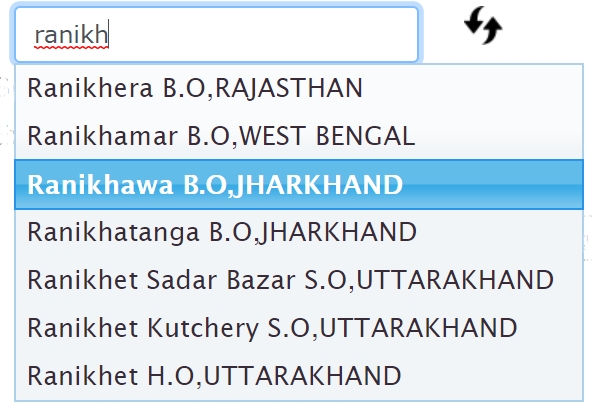
Post the Typed Term to the Backend Top ↑
$( "#t1" ).autocomplete({
    delay: 400,
    minLength: 2,

    source: function ( request, response ) {
        $.getJSON(
            "indexck.php",
            { term: request.term }
        )
        .done( response )
        .fail( function () {
            response( [] );
        } );
    }
});
Load Full Details after Selection Top ↑
select: function ( event, ui ) {
    event.preventDefault();

    this.value = ui.item.label;

    $( "#d2" ).load(
        "indexck-dtl.php",
        { id: ui.item.value }
    );

    return false;
}
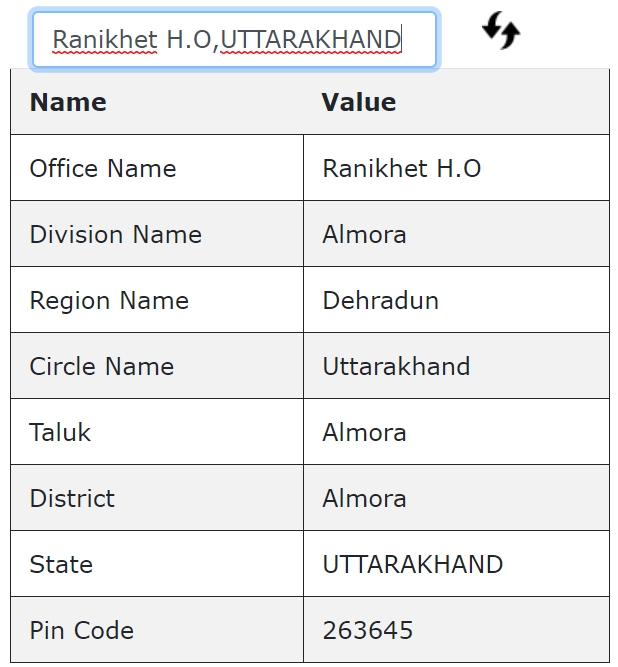
This uses jQuery load() to request the selected record details.
Complete Client-Side Pattern Top ↑
$( function () {
    const $input = $( "#t1" );

    $input.trigger( "focus" );

    $input.autocomplete({
        delay: 400,
        minLength: 2,

        source: function ( request, response ) {
            $.getJSON(
                "indexck.php",
                { term: request.term }
            )
            .done( response )
            .fail( function () {
                response( [] );
            } );
        },

        select: function ( event, ui ) {
            event.preventDefault();
            this.value = ui.item.label;

            $( "#d2" ).load(
                "indexck-dtl.php",
                { id: ui.item.value }
            );

            return false;
        }
    });

    $( "#img1" ).on( "click", function () {
        $input.val( "" ).trigger( "focus" );
        $( "#d2" ).empty();
    });
});
Filter Suggestions by State Top ↑
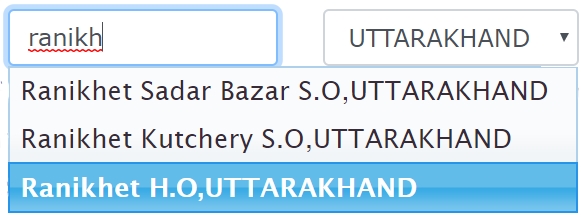
Demo: search city/location within a selected state →
Send both the text term and selected state to the backend:
source: function ( request, response ) {
    $.getJSON(
        "indexck.php",
        {
            term: request.term,
            statename: $( "#statename" ).val()
        }
    )
    .done( response )
    .fail( function () {
        response( [] );
    } );
}
When the state changes, trigger another Autocomplete search:
$( "#statename" ).on( "change", function () {
    $( "#t1" ).autocomplete( "search" );
});
Backend Search Query Top ↑
The original script combines WHERE conditions, LIKE matching and CONCAT() to produce labels such as Office Name, State. That search purpose is retained, but use prepared placeholders for every typed keyword and state value.
$term = trim($_GET['term'] ?? '');
$state = trim($_GET['statename'] ?? '');

$words = preg_split(
    '/\s+/',
    $term,
    -1,
    PREG_SPLIT_NO_EMPTY
);

$conditions = [];
$params = [];

foreach ($words as $index => $word) {
    $placeholder = ':term' . $index;
    $conditions[] = "officename LIKE $placeholder";
    $params[$placeholder] = '%' . $word . '%';
}

$where = '(' . implode(' OR ', $conditions) . ')';

if ($state !== '') {
    $where .= ' AND statename = :state';
    $params[':state'] = $state;
}

$sql = "
    SELECT
        CONCAT(officename, ', ', statename) AS label,
        id AS value
    FROM pincode_india
    WHERE $where
    ORDER BY officename
    LIMIT 30
";

$stmt = $pdo->prepare($sql);
$stmt->execute($params);

echo json_encode(
    $stmt->fetchAll(PDO::FETCH_ASSOC)
);
The earlier version used each() while building keyword conditions. That function was removed from modern PHP; foreach is the current pattern.
Detail Query Top ↑
The detail endpoint receives the selected record ID and should use a prepared statement.
$id = filter_input(
    INPUT_GET,
    'id',
    FILTER_VALIDATE_INT
);

$stmt = $connection->prepare(
    'SELECT *
     FROM pincode_india
     WHERE id = ?'
);

$stmt->bind_param( 'i', $id );
$stmt->execute();
Escape values before placing database text into HTML. The original tutorial links remain useful: fetch_array(), JSON output, and SELECT queries.
Files in the Downloadable Search Project Top ↑
| File | Purpose |
|---|---|
config.php | Database connection settings. |
index.php | Main location-search page. |
index-state.php | Search page with an additional state filter. |
indexck.php | Returns matching label/value suggestions. |
indexck-dtl.php | Returns details for the selected record ID. |
sql_dump.txt | Sample database/table data. |
templates/head.php, templates/bottom.php | Project page shell/assets. |
Download the existing Autocomplete Search ZIP
Continue Learning jQuery

Subhendu Mohapatra
Author & Instructor at plus2net
I write and maintain practical tutorials on Python, PHP, SQL, JavaScript, HTML, jQuery, and web development at plus2net. The tutorials focus on clear explanations, working examples, and code that readers can test and adapt while learning.