jQuery UI Autocomplete
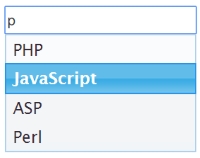
jQuery UI Autocomplete displays matching suggestions while a user types into an input. The source can be a local array, a URL that returns JSON, or a custom function that calls an API or database backend.
Basic Autocomplete Top ↑
<input id="auto_c">
$( function () {
    $( "#auto_c" ).autocomplete({
        source: [
            "PHP",
            "jQuery",
            "JavaScript",
            "HTML",
            "ASP",
            "MySQL",
            "Access",
            "Excel",
            ".NET"
        ]
    });
});
Demo: Autocomplete with an array source →
Demo: display database record details after selection →
Video: Autocomplete with an Array Source
Autocomplete Options Top ↑
appendTo
Choose the element that should contain the suggestion menu. This is useful when the input is inside a positioned dialog or another stacking context.
$( "#auto_c" ).autocomplete({
    appendTo: "#my_element"
});
Read the current value:
const appendElement =
    $( "#auto_c" ).autocomplete( "option", "appendTo" );
Set it later:
$( "#auto_c" ).autocomplete(
    "option",
    "appendTo",
    "#my_element"
);
autoFocus
When true, the first menu item receives focus automatically when the menu opens.
$( "#auto_c" ).autocomplete({
    autoFocus: true
});
const autoFocus =
    $( "#auto_c" ).autocomplete( "option", "autoFocus" );

$( "#auto_c" ).autocomplete(
    "option",
    "autoFocus",
    true
);
classes
Add your own classes to jQuery UI structural classes.
$( "#auto_c" ).autocomplete({
    classes: {
        "ui-autocomplete": "ui-state-highlight"
    }
});
const menuClass =
    $( "#auto_c" ).autocomplete(
        "option",
        "classes.ui-autocomplete"
    );

$( "#auto_c" ).autocomplete(
    "option",
    "classes.ui-autocomplete",
    "my-autocomplete-menu"
);
delay
delay is the number of milliseconds Autocomplete waits after typing before starting a search. Smaller values feel responsive for local data; remote sources may use a slightly larger delay to reduce requests.
$( "#auto_c" ).autocomplete({
    delay: 200
});
const delay =
    $( "#auto_c" ).autocomplete( "option", "delay" );

$( "#auto_c" ).autocomplete( "option", "delay", 400 );
disabled
$( "#auto_c" ).autocomplete({
    disabled: true
});
const disabled =
    $( "#auto_c" ).autocomplete( "option", "disabled" );

$( "#auto_c" ).autocomplete( "option", "disabled", false );
minLength
Require a minimum number of characters before a search starts. Higher values can reduce unnecessary database requests.
$( "#auto_c" ).autocomplete({
    minLength: 2
});
const minLength =
    $( "#auto_c" ).autocomplete( "option", "minLength" );

$( "#auto_c" ).autocomplete( "option", "minLength", 3 );
position
Control where the menu appears relative to the input.
$( "#auto_c" ).autocomplete({
    position: {
        my: "left top",
        at: "right bottom"
    }
});
const position =
    $( "#auto_c" ).autocomplete( "option", "position" );

$( "#auto_c" ).autocomplete(
    "option",
    "position",
    {
        my: "right top",
        at: "right bottom"
    }
);
const options =
    $( "#auto_c" ).autocomplete( "option" );

$( "#d2" ).text(
    "position my: " + options.position.my +
    ", position at: " + options.position.at
);
source
source is required. It can be an array, a URL string, or a function.
$( "#auto_c" ).autocomplete({
    source: [
        "PHP",
        "jQuery",
        "JavaScript",
        "HTML",
        "MySQL"
    ]
});
A custom source function is the most flexible choice for database/API results:
$( "#auto_c" ).autocomplete({
    source: function ( request, response ) {
        $.getJSON(
            "autocomplete-demo1-dtl.php",
            { term: request.term }
        ).done( response );
    }
});
Autocomplete Methods Top ↑
close()
$( "#auto_c" ).autocomplete( "close" );
destroy()
$( "#auto_c" ).autocomplete( "destroy" );
disable()
Disable Autocomplete without destroying the widget.
$( "#auto_c" ).autocomplete( "disable" );
$( "#auto_c" ).autocomplete( "enable" );
enable()
Re-enable an Autocomplete instance that was previously disabled.
$( "#auto_c" ).autocomplete( "enable" );instance()
const autocompleteInstance =
    $( "#auto_c" ).autocomplete( "instance" );
option()
Read one option:
const minLength =
    $( "#auto_c" ).autocomplete( "option", "minLength" );
Read the complete option object:
const options =
    $( "#auto_c" ).autocomplete( "option" );
Demo: read the option object →
search()
Trigger a search programmatically. Pass a string or omit the argument to search using the current input value.
$( "#auto_c" ).autocomplete(
    "search",
    "java"
);
Demo: search() with preset strings →
widget()
const menu =
    $( "#auto_c" ).autocomplete( "widget" );
Autocomplete Events Top ↑
change
Fires when the input loses focus and the value has changed.
$( "#auto_c" ).autocomplete({
    change: function ( event, ui ) {
        console.log( "Changed value:", this.value );
    }
});
close
$( "#auto_c" ).autocomplete({
    close: function ( event, ui ) {
        console.log( "Menu closed" );
    }
});
create
$( "#auto_c" ).autocomplete({
    create: function ( event, ui ) {
        console.log( "Autocomplete created" );
    }
});
focus
Fires when focus moves to a menu item without selecting it.
$( "#auto_c" ).autocomplete({
    focus: function ( event, ui ) {
        $( "#status" ).text(
            "Focused: " + ui.item.label
        );
    }
});
open
$( "#auto_c" ).autocomplete({
    open: function ( event, ui ) {
        console.log( "Suggestion menu opened" );
    }
});
response
Fires after the source returns results, before the menu is displayed.
$( "#auto_c" ).autocomplete({
    response: function ( event, ui ) {
        $( "#status" ).text(
            ui.content.length + " suggestions returned"
        );
    }
});
search
Fires before a search begins. Returning false cancels the search.
$( "#auto_c" ).autocomplete({
    search: function ( event, ui ) {
        return this.value.trim().length >= 2;
    }
});
select
Fires when the user chooses a menu item. A common database pattern shows the label in the input while keeping the record ID in ui.item.value.
$( "#auto_c" ).autocomplete({
    select: function ( event, ui ) {
        event.preventDefault();

        this.value = ui.item.label;

        $( "#record_id" ).val(
            ui.item.value
        );
    }
});
Autocomplete Data Sources Top ↑
Keep suggestions in JavaScript and use a separate value/ID for the selected item. Database source
Request matching records from PHP/MySQL or another backend. Live remote database suggestions
Type a student name and retrieve label/value suggestions from the PHP/PDO endpoint. Load full details after selection
Use the selected record ID to request more information. Location/PIN-code search
Search a larger database and optionally filter suggestions by state.
Download the existing Autocomplete example ZIP
Continue Learning jQuery

Subhendu Mohapatra
Author & Instructor at plus2net
I write and maintain practical tutorials on Python, PHP, SQL, JavaScript, HTML, jQuery, and web development at plus2net. The tutorials focus on clear explanations, working examples, and code that readers can test and adapt while learning.


