substr_count(): counting presence of sub string inside a main string.
Count substring occurrences
substr_count() counts non-overlapping occurrences of a substring, optionally within a selected range of the main string.
$text = 'one two one three one';
echo substr_count($text, 'one'); // 3
$my_string="PHP is a server side script and learn PHP at www.plus2net.com";
echo substr_count($my_string,"PHP");
Syntax
substr_count(string $haystack,string $needle,int $offset, int $length);
| Parameter | DESCRIPTION |
|---|---|
| $haystack | Required : Input string |
| $needle | Required : substring to be searched within Input string |
| $offset | Optional : Where to start counting. If negative (in PHP 7 only ) then from end of the input string |
| $length | Optional : The maximum length after the $offset to search for the substring. If negative ( in PHP 7 only ) then count from end of the haystack ( input string ) only. Sum of offset and $length should not be more than the lenght of $haystack ( Warning as output ) |
Within a string we can count number of occurrence of another string by using substr_count function. This function takes the main string and the search string as inputs and returns number of time search string is found inside the main string.
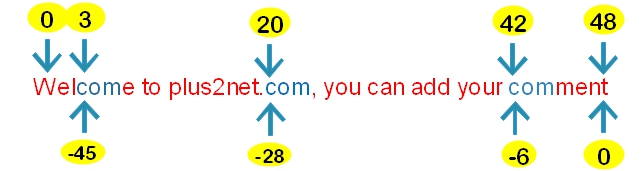
Use the above string to match the outputs given.
$string="Welcome to plus2net.com, you can add your comment";
echo strlen($string); // Output is 49 ( length of the string )
echo substr_count($string,'com');       // Output is 3
echo substr_count($string,'com',3);     // Output is 3
echo substr_count($string,'com',4);     // Output is 2
echo substr_count($string,'com',20);     // Output is 2
echo substr_count($string,'com',21);     // Output is 1
echo substr_count($string,'com',3,3);  // Output is 1
echo substr_count($string,'com',4,3);  // Output is 0
echo substr_count($string,'com',0,10);  // Output is 1

echo substr_count($string,'com',4,18);  // Output is 0
echo substr_count($string,'com',4,19);  // Output is 1
echo substr_count($string,'com',20);    // Output is 2
echo substr_count($string,'com',20,29); // Output is 2
// The invalid call substr_count($string, 'com', 20, 30) throws ValueError
// because 20 + 30 exceeds the 49-byte haystack length.
PHP 7 and negative $offset and $length
PHP 7 supports negative value for $offset and $length ( $length can be 0 also ) .Try these codes in PHP 7
$string="Welcome to plus2net.com, you can add your comment";
//echo strlen($string); // Output is 49 ( length of the string )
// Negative offsets and lengths (PHP 7.1+)
echo substr_count($string,'com',-49);    // Output is 3
echo substr_count($string,'com',-49,-4); // Output is 3
echo substr_count($string,'com',-49,-5); // Output is 2
echo substr_count($string,'com',-47,-4); // Output is 3
echo substr_count($string,'com',-49,-7); // Output is 2
echo substr_count($string,'com',-49,-26);// Output is 2
echo substr_count($string,'com',-49,-27);// Output is 1
echo substr_count($string,'com',-29,-26);// Output is 1
echo substr_count($string,'com',-28,-26);// Output is 0
Counting is not email validation
substr_count() can count @ symbols, but that alone cannot establish whether an email address is valid. For submitted email addresses, validate the complete input with filter_var() and FILTER_VALIDATE_EMAIL. The next example demonstrates the distinction.
$email = "user@example.com";
$atCount = substr_count($email, "@"); // Character count only
$isValid = filter_var($email, FILTER_VALIDATE_EMAIL) !== false;
if ($isValid) {
    echo "Valid email format";
}
Validation of an address does not establish that the mailbox exists or accepts delivery.
String Functions substr(): Collecting part of the string

Subhendu Mohapatra
Author & Instructor at plus2net
I write and maintain practical tutorials on Python, PHP, SQL, JavaScript, HTML, jQuery, and web development at plus2net. The tutorials focus on clear explanations, working examples, and code that readers can test and adapt while learning.


Subscribe to our YouTube Channel here

| Paul, copySnips.com | 02-09-2009 |
| Thanks for sharing this example. Very useful. | |
| John | 13-10-2014 |
| Very useful thanks! | |
